Designing the museum
How do you design a design museum?
A list of different design aspects that have gone into V&A Dundee. The article will briefly explain each one using one or two images and around 100 words. It will be a neat "design" way of introducing elements of our new museum that may otherwise not get mentioned or highlighted in other ways, but that show the detail involved in putting together a new organisation, especially a design museum. The range of details showcased will give a varied snapshot across the museum.
Lanyards
What’s the first thing you notice when you enter a brand-new museum? It’s probably not the lanyards worn by staff and visitors, but even these have been playfully designed at V&A Dundee.
We have lanyards in the museum for our Staff, their Visitors and our Contractors. These three different uses mean each type must be visually distinct from a distance, both for security and customer service purposes.
This presented us with a fun challenge. We needed to find three complementary colours that: work as a suite; are vibrant and obvious; move away from the more expected and functional colours other places might use.
We started experimenting with different colour palettes based on our building and its interiors, as well as V&A South Kensington’s brand colours. And in a moment of inspiration, the CMYK colour model came to us.
This model is used in colour printing. Not only is that appropriate given Dundee’s printing history, but the colours themselves are bold and clear:Cyan, Magenta and Yellow (the K stands for “Key”, which nowadays mostly means black).
Shop
No museum visit is complete without a look in the shop. Extending our mission to enrich lives through design, our shop offers accessible, every-day products which celebrate quality and innovation of design both nationally and internationally. Like the products in it, the shop itself was carefully designed.
Lumsden, a team of retail specialists and interior designers, were hired to design a unified approach to the shop, café and restaurant. As part of a specialised collective, Lumsden have a unique understanding of cultural commerce and environments.
Positioned openly in our main hall, our shop posed a few design challenges for Lumsden. We wanted to create a visually outstanding design to reflect Kengo Kuma's architectural vision, while providing the operational requirements of the shop and wider museum. The space and furniture had to be flexible, with efficient storage, allowing us to respond to the day to day needs of the main hall as a dynamic museum with a changing programme of events. Finally, the design had to incorporate sustainable materials.
Interesting materials used in the shop include signage and pricing blocks in Mirrl: a solid surface material on a birch plywood substrate. Mirrl has a distinctive organic pattern and is hand-made in small batches in Glasgow, using a technique inspired by Japanese lacquerware from the island of Hokkaido. The custom concrete used for the counter contains sustainably sourced mussel shells, and reflects the River Tay on which the museum sits.
Our shop showcases contemporary Scottish designers and is proud to have worked with a selection of these makers and manufacturers on exclusive collaborations.
Landscaping
V&A Dundee is Landscape Architect, Scott Thomson from OPEN explains:
“The big idea for V&A Dundee was bringing together nature and architecture, and to create a new living room for the city."
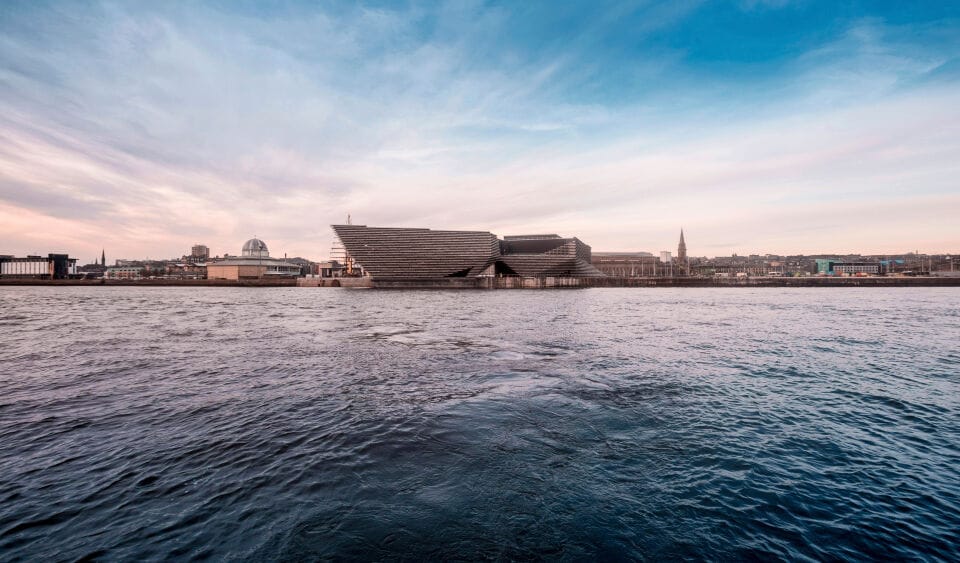
The form of the museum is inspired by the cliffs on Scotland’s north-eastern coastline, with the cladding creating patterns of shadows which change with the weather and the time of day. Landscaping around the building extends this approach to its immediate surroundings.
Part of the architectural brief for V&A Dundee was to reconnect the city centre with the river, which Kengo Kuma has done through water pools around the museum and by building the museum out into the River Tay.
"We were challenged with providing an appropriate setting for the building whilst creating an enticing public realm that people can enjoy. A simple approach was established, using a single tone of granite to create the series of spaces and walkways that can accommodate activity and performance, and allow people to explore the outside of the building and enjoy the waterfront location. Significant water features were included to set the building within a ‘dock’ environment.
We wanted to create a space that provides a setting for the new V&A building, but also provides opportunity for associated performance, exhibition and related activity. It is a space that allows people to explore the edge of the waterfront, discovering the spaces formed by the new architecture, and appreciating the views that open up across the Tay.
Every detail needed to be considered and resolved. How materials were to be cut, terminated and edged were reviewed, as was the approach to the soft landscape elements of the scheme. Other considerations included access control, delivery of museum objects, servicing, façade cleaning and refuse collection. All these considerations can add elements and complexity into a scheme, but at each stage the challenge was to keep with a restricted palette and simple layout.
In terms of the vegetation, clusters of London Plane and Himalayan Birch ‘Doorenbos’ provide a focus for seating areas at the Eastern end of the site. The Birch have a striking white trunk and branches which can be read against the façade of the building and their light canopy softens views to the building from the east while not obstructing it completely. The London planes are fantastic large trees which give the site a solid natural presence which contrasts with the man-made development. Their main feature is a patterned bark which is a natural reflection of the building façade. All tree species are hardy to wind and salt exposure.
The planting beds contain a mix of grasses, herbaceous perennials and woody shrubs which provide year round colour, texture, and scent and give a tactile human scale to the eastern end of the development. The species, Korean feather reed grass, Mexican feather grass, lavender, Siberian dogwood, sea holly, and ornamental onion, are all hardy to the location and the same mix can be seen and has been tested beneath the Tay road bridge."
Wayfinding?
Melissa writing something
1 What was your biggest challenge?
Internally, there was much debate about whether we should integrate signage elements to the horizontal timber cladding, or if the cladding should be left pure and uninterrupted as the primary expression of the interior language. Working closely with the client and architect we persuaded them to allow us to fix key signs onto the timber planks. Our design treatment of these signs is sensitive to the rhythm and form of the planks and by clipping onto them and exposing the timber through stencil-cut numbers they look perfectly integrated - they become a part of the interior language, which is what we always strive to achieve.
Externally, determining the most appropriate way to sign the main entrance was our biggest challenge. After much exploration and discussion with the architect, we arrived at the concept of a large scale logo, located in the water. It was clear to us that the logo should be a sculptural element sitting on the ground rather than mounted onto the building. The building takes the form of two inverted pyramids with a central triangular arch and triangular openings which all subtly reflect the angles of the V&A logo. By sitting the logo forward of the building, a powerful connection is made between building and logo. The reflections of the logo in the pool create an ever changing mood, adding to the sense of arrival.
2 How did you design wayfinding for a building you couldn’t get into and use fully?
This is something we are accustomed to, as we often work with clients and architects from the earliest part of the project, working off plans, elevations and a number of key CGIs. On some projects there is a 3D digital model which we can use to ‘walk’ around the space and experience the architecture and sight lines from a visitor's perspective. We also make visits to site as soon as the building is beginning to take form, even on a muddy building site with only a few walls in place, it all helps us understand the scale and overall feel of the space.
3 What inspired you?
Our approach is very much led by the architecture. We always strive for an integrated approach, we think the signage should appear to be an intended element of the architecture and interior, not an ‘add on’ after it’s complete. This building provided us with a lot of inspiration, from the purely visual aspects of the architecture, its extraordinary geometry and the gravity-defying angles of its walls, to the sheer ambition and vision of the project overall. This is truly a unique and awe-inspiring building and Kengo Kuma’s reference to nature and organic form makes the spaces warm and human. This in turn inspired us to create a signage design language that harmonised with this vision.
4 How did you choose the font/colours?
The font is V&A Sans, as V&A Dundee sits under the umbrella of the V&A brand, this bespoke font is used throughout the V&A’s communications. We always like to find colours that respond to the building’s material palette, and having determined the key positions for signs on the timber cladding, on white painted walls and on raw concrete, we selected a bright acidic yellow to work as a highlight against these different surfaces.
The colours are chosen to both harmonise with, and stand-out from, the architecture so that visitors notice information at key points of their journey, but read the signs as an integral part of the interior and external landscape.
Accessibility
TO EDIT
V&A Dundee has been made as accessible as possible and we're proud of the feedback we've received so far. One of the small ways...
In 2015, shortly after her diagnosis with Crohn’s disease, nine-year-old Grace Warnock decided she wanted to change how people reacted to those who needed to use a disabled toilet but didn’t have a visible disability.
The idea came after Grace met some volunteers from CCUK (Crohn’s and Colitis UK) and they discussed what it was like to live with the condition on a daily basis.
Grace says, “The thing we had in common was people with invisible conditions sometimes face being judged when using a disabled toilet, because although they need the facilities they didn’t look like they should be allowed. No one should be judged and verbally abused for using toilet facilities just because someone decides that they are not disabled enough.”
As a result of those conversations, Grace designed a new sign to show that not all disabilities are immediately obvious. The sign shows people standing alongside a person in a wheelchair, making clear that the facilities are for people with a range of needs. Those standing have a heart symbol on their chest, both representing invisibility and reminding others to have a heart and not judge what can’t be seen.
Grace sent the design and a letter to her local MSP, Iain Gray, who arranged to meet her at the Scottish Parliament and invited along representatives from disability forums. During discussions the ‘Grace’s Sign’ campaign was born and the first sign was displayed at the Scottish Parliament. The sign has since been installed across the country including at sports centres in East Lothian and Inverclyde, as well as at Edinburgh Airport.
Grace’s Sign will be featured as part of the accessible bathroom facilities for visitors at V&A Dundee when we open on Saturday 15 September. The museum will also have a Changing Places toilet for visitors with profound disabilities.